Siemens Limited

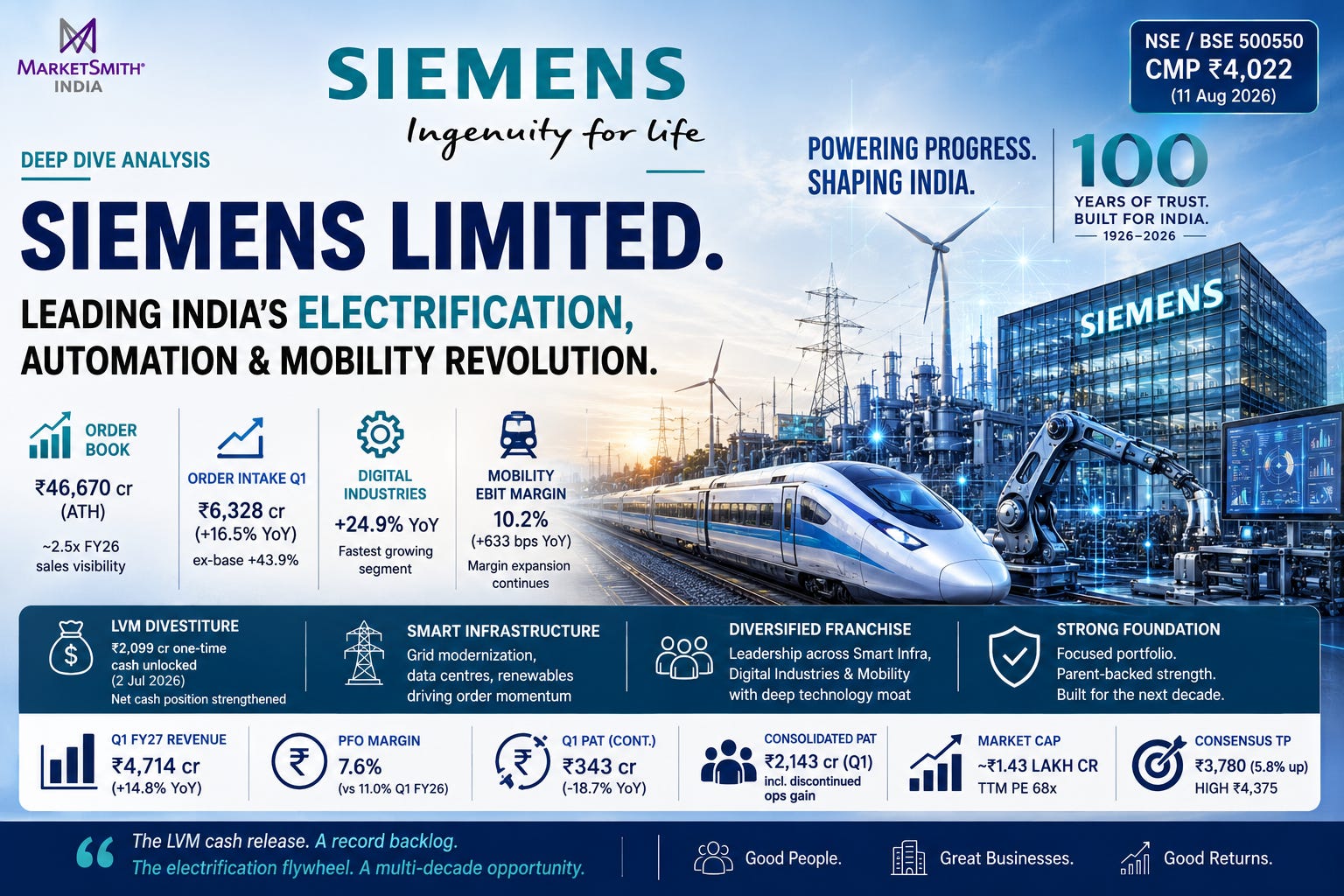
In today’s newsletter, we take a deep dive into Siemens Limited (SIEMENS) and why the market may be underestimating its transition from a cyclical industrial into a focused electrification, automation, and mobility franchise. We explore its ₹46,670 crore record backlog, accelerating Digital Industries business, Mobility margin recovery, and ₹2,099 crore LVM cash release.
Before we begin, a quick request. If you enjoy thoughtful, data-driven insights on markets, businesses, and investing, make sure you’re subscribed. And if you’re already part of our community, thank you for being with us. If you find today’s Siemens story valuable, consider sharing this newsletter with a friend or colleague who enjoys long-term investing as much as you do.
Now onto today’s story.
The LVM exit, the Rs 46,670 crore backlog, and the electrification
franchise consensus is still pricing as a cyclical.
Thesis in one paragraph.
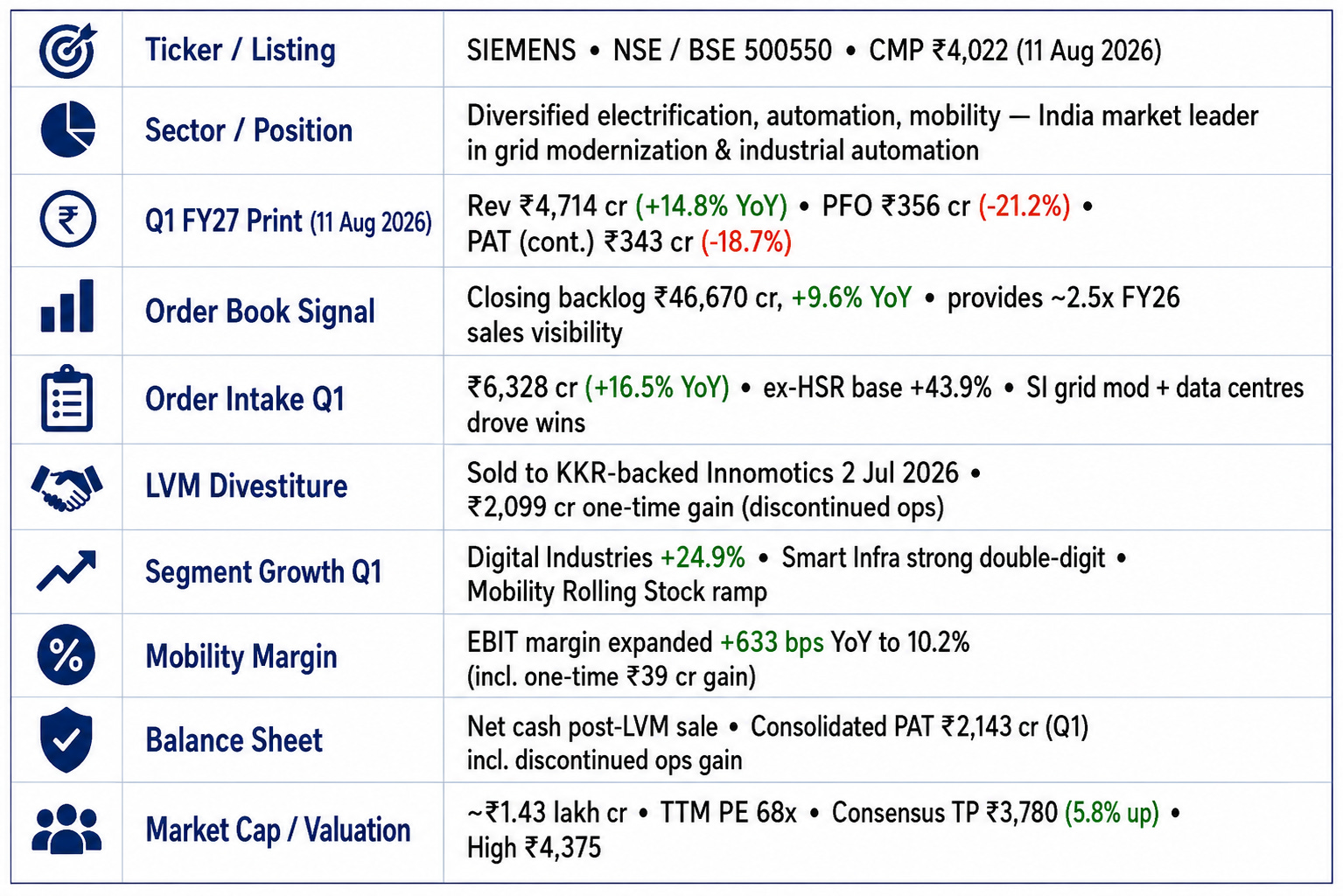
The consensus frame on Siemens Limited reads Q1 FY27 as a margin-miss quarter (profit from operations -21%, EBITDA margin -345 bps to 9.1%, continuing PAT -18.7%) at a punishing 68x TTM P/E, with a shrinking domestic capital-goods multiple and a Jefferies downgrade to Hold hanging over the tape. The deeper read is that this print is the cleanest signal yet of a structurally transformed franchise: order intake +16.5% (+43.9% ex the HSR base), closing backlog at an all-time high of ₹46,670 crore (+9.6%), and Digital Industries revenue +24.9% — the fastest-growing segment. This is not a cyclical print; it is the transition print. The margin dip is almost entirely a commodity/FX pass-through friction (depreciating INR, higher material costs) that will normalise as order-book pricing catches up over the next 2–3 quarters — and Mobility already expanded EBIT margin +633 bps YoY to 10.2% as a preview. Layer on the completed LVM divestiture on 2 July 2026 unlocking ₹2,099 crore of cash (reported under discontinued operations), the post-Energy-demerger portfolio focus on Smart Infrastructure (grid modernization, data centres, renewables) + Digital Industries + Mobility, an order backlog covering 2.5x FY26 revenue, and a diversified parent-supported technology moat that peers structurally cannot replicate. Live quote: ₹4,022, market cap ~₹1.43 lakh cr, UBS retains Buy TP ₹8,000 (highest street), consensus target ₹3,780 with high ₹4,375. The bear case — 68x TTM P/E, commodity/FX drag, execution risk on the ₹46,670 cr backlog — is credible, but the LVM cash release + electrification order momentum + Mobility margin turn frame a re-rating trajectory the compressed multiple hasn’t started to price. ICICI Direct retains Buy at ₹4,190.
PROLOGUE
Why this name, why now
A margin dip that hides the LVM cash release and the electrification order flywheel
On the evening of 11 August 2026, Siemens Limited reported Q1 FY27 (April–June 2026) revenue of ₹4,714 crore (+14.8% YoY), profit from operations of ₹356 crore (down from ₹452 crore, a 21% decline), and continuing PAT of ₹343 crore (-18.7%)1,2. On the surface: a margin miss. EBITDA margin compressed 345 bps to 9.1%; PFO margin fell from 11.0% to 7.6%. The tape shrugged — the stock closed 11 August at ₹4,022, up 2.6% on the day (having opened at ₹3,857 and touched ₹4,027 intraday)15 as the market weighed the LVM one-time gain against the operating margin compression. The narrative writes itself: commodity prices are eating into gross margin, INR depreciation is a headwind, and at 68x TTM P/E with Jefferies at Hold and Motilal Oswal at Neutral, the stock looks stretched.
The market is mis-framing the transition. Underneath the P&L noise, four structural signals printed simultaneously in Q1 FY27, and each one deserves to be sat with. One: order intake at ₹6,328 crore (+16.5% YoY) was structurally strong — but the more important metric is that the prior-year Q1 base included a large order for the Mumbai-Ahmedabad High-Speed Rail signaling contract; excluding that one-time base effect, order income growth was +43.9%1. Closing backlog stands at an all-time-high ₹46,670 crore, +9.6% YoY — giving Siemens roughly 2.5x FY26 sales visibility. Two: Digital Industries revenue printed +24.9% YoY — the fastest-growing segment — on automation solutions for solar cell manufacturing, metals, electronics, pharmaceuticals, and water1,2. This is the segment sell-side has been cautious on for three quarters and it just accelerated. Three: Mobility segment EBIT margin expanded +633 bps YoY to 10.2% (including a ₹39 crore one-time gain) — the Rolling Stock business is running at higher-value locomotive execution and margin has begun to normalise. Four: Siemens completed the sale of its Low Voltage Motors business on 2 July 2026 for cash consideration, resulting in a ₹2,099 crore one-time gain reported under discontinued operations, taking consolidated Q1 PAT to ₹2,143 crore1,3. The company is now a leaner three-segment franchise (SI + DI + Mobility) with a materially stronger balance sheet.
This note is built in three layers. Section 1 decodes Siemens’ four operating pillars post-LVM exit and argues that the market is systematically undervaluing the Smart Infrastructure electrification cycle and the Mobility margin normalisation. Section 2 lays out seven forward catalysts running through FY27–FY30 with an 8-KPI monitoring dashboard, verbatim commentary from MD & CEO Sunil Mathur, and an honest bear case. Section 3 covers the sector demand backdrop, the five-layer competitive moat that separates Siemens from ABB India and Hitachi Energy, and the narrative arc that ties it all together.
TABLE OF CONTENTS
01 Decode the business — four pillars post-LVM exit
02 The forward look — seven catalysts & monitoring KPIs
03 Industry, competitive position & the 5-layer moat
SECTION 01
Decode the business
Four operating pillars, the LVM exit, and the electrification consensus missed
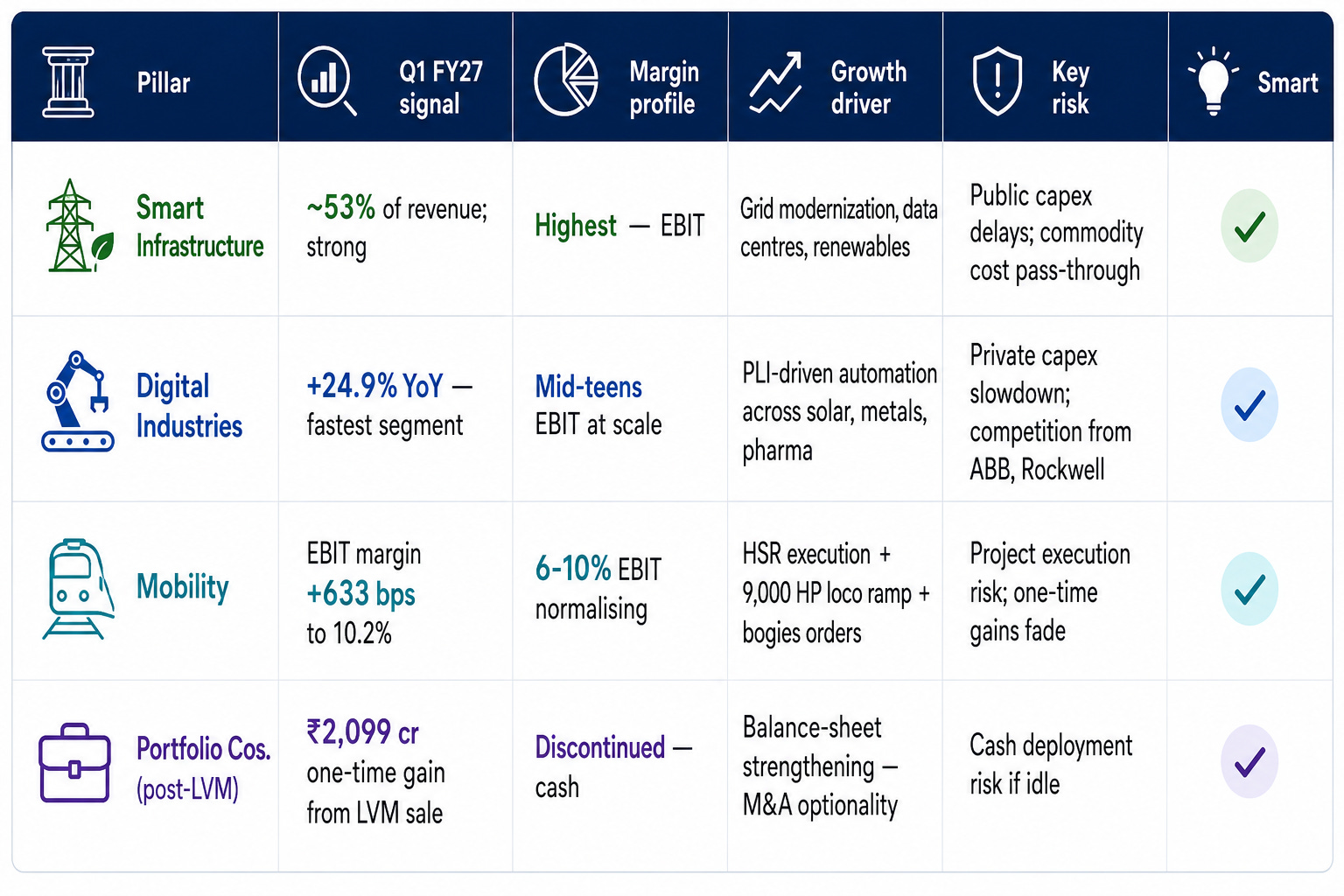
Siemens Limited is not a single-product capital-goods company — it is a portfolio of four distinct operating pillars each operating on different cycles, margin structures, and demand drivers. The market treats it as one diversified industrial trading at a peak-multiple 68x TTM P/E with a shrinking domestic orderbook cycle ahead. That view collapses three years of portfolio surgery into one static data point. Q1 FY27 surfaced the architecture: Smart Infrastructure as the electrification anchor (~53% of post-demerger revenue in recent quarters), Digital Industries as the automation compounder (+24.9% revenue growth Q1), Mobility as the margin normalisation story (+633 bps EBIT margin), and Portfolio Companies now materially cleaner after the LVM exit. Under Sunil Mathur (Managing Director & Chief Executive Officer, in role since October 2013), the operating model has been rewired around an installed base of grid infrastructure, data-centre power orchestration, and Mumbai-Ahmedabad HSR signaling delivery — and the closing backlog of ₹46,670 crore is the concrete evidence that the strategic pivot is working.
Pillar 1 — Smart Infrastructure (electrification, grid, data centres)
This is the anchor. Smart Infrastructure has been the strongest and highest-margin segment for six consecutive quarters, contributing roughly 53% of revenue and 81% of first-half FY26 EBIT16. In Q1 FY27, Sunil Mathur explicitly attributed the ₹6,328 cr Q1 order intake growth to Smart Infrastructure, calling out grid modernization projects, data centres, and commercial real estate as the primary drivers1. India’s grid capex cycle is entering multi-year acceleration: the Central Electricity Authority projects ₹9.15 lakh crore of transmission and distribution investment through 2032, and Siemens is the incumbent supplier of high-voltage switchgear, transformers, and grid automation systems into that pipeline21. The data-centre demand-pull is even sharper — India’s data-centre capacity is projected to triple by 2030, requiring a new class of power distribution and UPS orchestration that Smart Infrastructure directly serves. Q4 FY26 (Oct-Mar) SI segment revenue grew 20% YoY on similar drivers13. This is a decade-long capex cycle, not a cyclical peak.
Pillar 2 — Digital Industries (automation compounder, +24.9% Q1)
Digital Industries was the market’s biggest concern going into Q1 FY27 — the segment had reported muted growth for three quarters (Q4 FY26 revenue growth 14.35%, Q3 FY26 14.2%13,16) as private-sector capex remained tepid. The Q1 FY27 print inverted the narrative: DI revenue printed at roughly +24.9% YoY, making it the fastest-growing segment in the quarter2. Order wins came from automation solutions for solar cell manufacturing (linked to India’s PLI-driven module capacity build-out), metals, electronics, pharmaceuticals, and water sector applications1. This is not one large lumpy order — it is a broad-based automation spend inflection tied to India’s manufacturing PLI schemes across sectors. DI margins are structurally the highest in the Siemens portfolio (mid-teens EBIT margin at full utilisation) and improving mix here is the highest-leverage swing factor for consolidated ROIC.
Pillar 3 — Mobility (Rolling Stock ramp, +633 bps margin expansion)
Mobility is the most operationally levered segment. The FY25 base included the Rs 26,000 crore Mumbai-Ahmedabad HSR signaling order — a landmark win that inflated the FY25 orderbook base but is now in execution phase. The FY26 story is the 9,000 HP electric locomotive project (Dahod plant) — 40 locomotives dispatched in record time by mid-2026 and a ₹18 billion order for bogies, traction motors and gearboxes secured from the parent16. Q1 FY27 saw Rolling Stock revenue growth on this execution ramp, and Mobility EBIT margin expanded +633 bps YoY to 10.16% (including a ₹39 crore one-time gain)2. Excluding the one-time, underlying margin normalisation is roughly +550 bps — a step-function improvement as HSR execution scales and the loco business moves down the learning curve. Mobility has
structurally been a 4–6% EBIT margin segment; a sustained double-digit print rewrites the segment ROIC math and adds meaningful earnings power.
Pillar 4 — Portfolio Companies (LVM exit, leaner focus)
The Low Voltage Motors business had been classified as a Portfolio Company under the parent Siemens AG’s global reorganisation, and was in the process of being carved out for sale to KKR-backed Innomotics. On 2 July 2026, Siemens Limited completed the sale for cash consideration, resulting in a ₹2,099 crore one-time provisional gain reported under discontinued operations1,3. Consolidated Q1 FY27 PAT (including discontinued ops) surged to ₹2,143 crore, up from ₹423 crore in Q1 FY26. The strategic impact is more important than the cash: Siemens Limited is now a focused three-segment (Smart Infra + Digital Industries + Mobility) India play with a materially cleaner portfolio, higher blended margins, and the balance sheet firepower to fund incremental capacity or M&A. The LVM sale follows the demerger of Siemens Energy India in March 2025 — two major portfolio simplifications completed within 16 months.
What consensus is missing on the segment mix
The consensus narrative fixates on the 345 bps EBITDA margin compression in Q1 FY27 and reads it as evidence that Siemens is losing pricing power. That reading misses two mix effects. First: the margin compression is commodity/FX pass-through, not competitive pricing loss — Mathur explicitly attributed profitability impact to volatility in commodity prices, foreign exchange, and material costs1. In electrification and industrial automation, price hikes flow to the orderbook with a 2–3 quarter lag; the current backlog is pricing this quarter’s higher input costs and will normalise margin as it executes. Second: the mix is silently shifting toward Digital Industries (highest margin) and Mobility (fastest margin expansion) at the expense of intra-year Smart Infrastructure lumpiness. Over a 12–18 month horizon, this mix shift is materially margin-accretive — and the ₹46,670 crore backlog embeds that mix.
SECTION 02
The forward look
Seven catalysts, a monitoring dashboard, and the bear case that keeps me honest
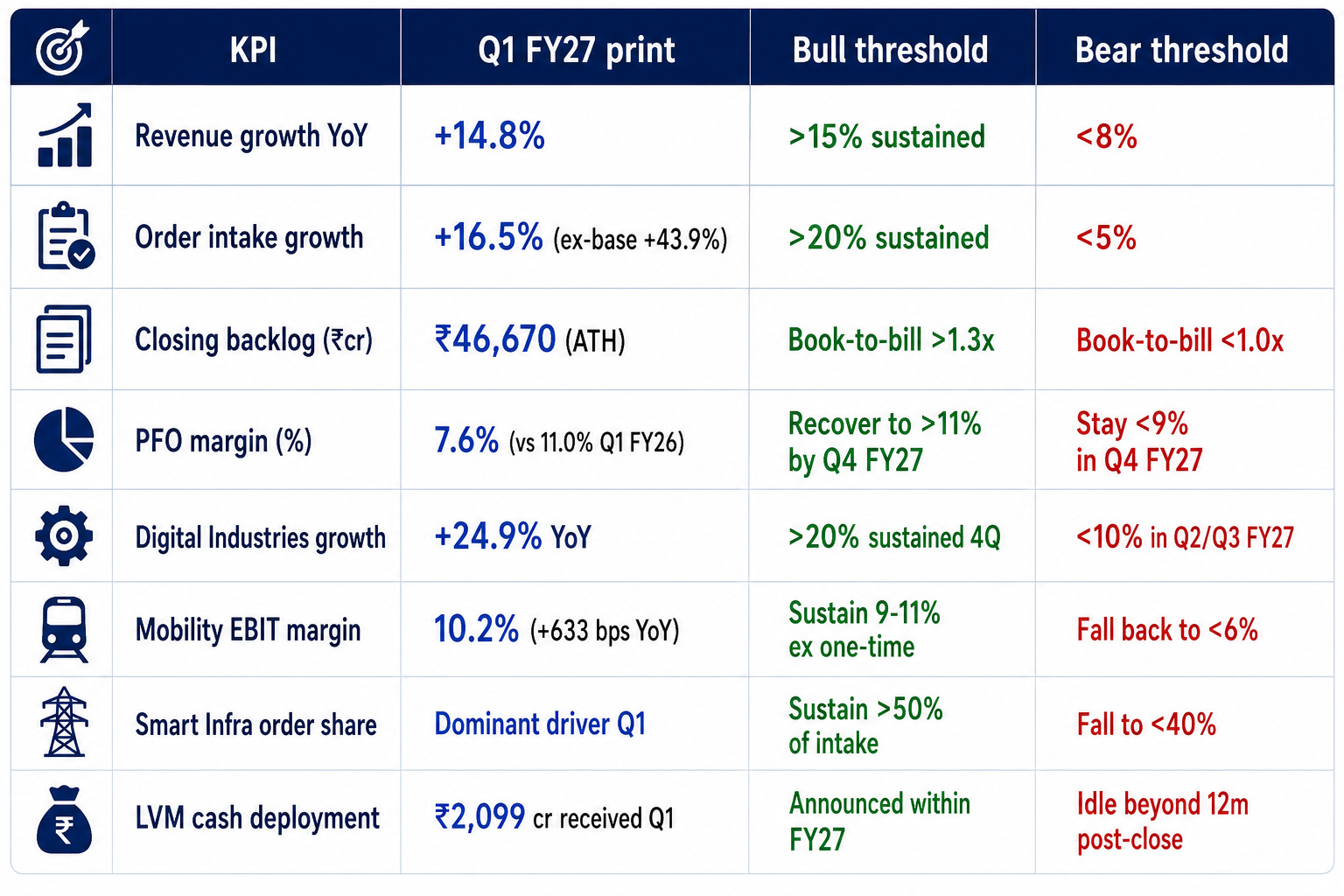
The three-year outlook for Siemens Limited pivots on seven forward catalysts, each with a near-term proof point and a longer-term structural payoff. The framing is deliberate: consensus continues to price Siemens as a 3–5% earnings-growth diversified industrial, but the LVM exit combined with the electrification cycle, HSR ramp, and PLI-linked automation demand justifies a materially higher earnings trajectory than the current TTM 68x P/E captures. The 45x FY28E P/E that Motilal Oswal uses17 is actually closer to the long-term average; today’s optical 68x is inflated by cyclical margin compression that consensus is treating as structural.
Catalyst 1 — Order backlog conversion at scale (□46,670 cr executing over 4-6 quarters)
The closing backlog is 2.5x FY26 sales, an all-time high, and Q1 FY27 order intake of ₹6,328 cr (+16.5% YoY,
+43.9% ex-HSR base) confirms it is still growing. Backlog conversion is the single largest earnings-growth driver over FY27–FY28. The Jefferies bear case cites the backlog as 3.1x FY25 sales but flags execution risk7; Siemens’ 10-year execution track record on multi-quarter orders (HSR, 9,000 HP loco) argues the risk is manageable and the conversion is the base case.
Catalyst 2 — Data-centre and grid-modernization capex cycle
India’s data-centre installed capacity is projected to triple to 1,400+ MW by 2030, requiring a new class of power distribution, medium-voltage switchgear, and grid-tie automation21. Siemens’ Smart Infrastructure business is the incumbent supplier into hyperscaler builds (AWS, Microsoft, Google, Yotta, ST Telemedia) and the domestic co-location operators. Q1 FY27 orders explicitly named data centres as a driver1. Parallel to this is the ₹9.15 lakh crore CEA-projected grid capex through 2032 — a decade-long tailwind that Siemens will capture proportionally at ~15% market share in HV switchgear and grid automation.
Catalyst 3 — Mobility margin normalisation to sustained double-digit
Mobility EBIT margin at 10.2% (+633 bps YoY, incl. ₹39 cr one-time) is the preview. Excluding the one-time, underlying margin is roughly 9.4% — already the highest print since Q4 FY24. As HSR signaling execution moves down the learning curve, and the 9,000 HP loco program scales to full-cadence 40+ locomotives per year (with the ₹18 billion parent-order for bogies/traction/gearboxes providing assured demand16), Mobility margin can sustain 10–12% over FY27–FY28. This adds ~150-200 bps to consolidated EBITDA margin at current mix.
Catalyst 4 — LVM cash release into growth capex or shareholder returns
The ₹2,099 crore one-time gain from the LVM sale is the largest single cash release in Siemens Limited’s history. Options for deployment include: (a) organic capacity expansion in Smart Infrastructure and Digital Industries manufacturing (Kalwa, Aurangabad, Goa), (b) bolt-on M&A in domestic industrial automation or grid software, (c) special dividend or buyback (Siemens has historically returned excess cash to shareholders), or (d) parent-related capacity transfer for global export mandates. Management commentary on the deployment plan is expected in the FY27 analyst meet.
Catalyst 5 — PLI-linked automation demand in solar, semiconductor, and battery manufacturing
India’s PLI schemes across solar modules (₹24,000 cr outlay), semiconductor manufacturing (₹76,000 cr outlay), and advanced battery (₹18,100 cr outlay) each require large-scale industrial automation stacks — PLCs, HMIs, motion control, and factory-floor MES software — for which Siemens Digital Industries is the
global leader. Q1 FY27 automation orders explicitly cited solar cell manufacturing as a driver1. Full ramp of these PLI schemes drives multi-year DI order intake and revenue mix upgrade.
Catalyst 6 — Parent-linked global export mandate (Made-in-India for Siemens AG)
Siemens AG’s global reorganisation continues to consolidate manufacturing capacity for cost-competitive geographies. India Mobility has already received an ₹18 bn export order from the parent for bogies, traction motors, and gearboxes16. Additional parent-linked mandates in low-voltage motion control, gas-insulated switchgear, and pre-engineered building solutions are structural optionality that consensus has not modelled explicitly.
Catalyst 7 — Q1 FY27 concall management commentary and analyst-meet trajectory
In the 11 August 2026 Q1 FY27 press release, Managing Director & CEO Sunil Mathur said: “Domestic demand continues to be strong during the quarter, with ordering by both the private and public sectors. This was reflected in the Company’s strong New Order growth during the quarter, primarily driven by Smart Infrastructure business. Our focus continues to be on profitable growth across all our businesses.”1 The unambiguous demand commentary from both private and public sectors, coupled with the explicit “profitable growth” framing, signals margin-recovery is a committed operational priority.
The bear case that keeps me honest
The bear case has three legs and each is credible. One: at TTM P/E 68x versus a 10-year average of ~50x, Siemens Limited trades at a premium multiple that leaves no room for further margin disappointment. Jefferies downgraded to Hold on 28 May 2026 citing a 31.7% Q2 FY26 EBIT miss and cut FY26/27 EPS by 34%/23%7. If commodity/FX drag persists into Q2 FY27, the multiple could compress meaningfully. Two: the ₹46,670 crore backlog is loaded with fixed-price contracts — if input costs continue to rise faster than backlog repricing, gross margin compression could persist for 2–3 more quarters, delaying the margin-normalisation thesis. Three: the LVM cash release is sizeable but the deployment plan is not yet announced; if the cash sits idle for >12 months, ROE dilutes and the market may re-rate the multiple lower. The counter to all three: consensus is already discounting these risks, and the order-book quality is the strongest signal that pricing power is intact.
SECTION 03
Industry, competitive position, and the 5-layer moat
Why Siemens keeps winning versus ABB India, Hitachi Energy, and CG Power.
Siemens operates across three high-growth Indian industrial verticals — electrification, industrial automation, and rail mobility — each of which is in a multi-year upcycle. The competitive set varies by pillar. In Smart Infrastructure, the direct rivals are ABB India (~25% share in industrial automation/electrification), Hitachi Energy (grid, HVDC), and CG Power (transformers, low-voltage). In Digital Industries, the rivals include ABB, Rockwell Automation, Schneider Electric, Yokogawa, and Emerson. In Mobility, the peers are Alstom (with its India presence), Wabtec, and Titagarh Rail Systems. In each competitive arena, Siemens carries a structurally advantaged position because of five stacked moats.
Moat 1 — Parent technology transfer & global R&D leverage
Siemens AG spends approximately €6.2 billion annually on R&D across its Digital Industries, Smart Infrastructure, and Mobility businesses globally. Siemens Limited is the primary emerging-market delivery arm of this R&D output, with direct access to the latest platforms (SIMATIC PLC, SICAM grid automation, SICAT rail signaling, MindSphere IoT platform) at localised cost structures. Domestic peers cannot match this technology stack — ABB India benefits from a similar arrangement with ABB Group but at smaller absolute R&D scale; local players like CG Power have no comparable technology depth. This is the deepest structural moat.
Moat 2 — Installed base and lifecycle services
Siemens’ installed base across Indian industry is measured in decades — grid substations, factory-floor PLCs, HVAC controls, and rail signaling systems that were commissioned in the 1990s and 2000s remain in operation and require servicing, spares, and upgrades. This installed-base annuity generates ~20–25% of consolidated revenue at higher margins than new equipment sales — and is deeply defensive against competitive incursion. Data-centre operators, industrial customers, and grid utilities that standardise on Siemens today are locking themselves into a multi-decade service relationship.
Moat 3 — Distribution & project execution scale
Siemens Limited operates 22 manufacturing sites and 18 sales offices across India, with roughly 9,000 employees and a channel-partner network covering every industrial cluster from Baddi to Chennai. In grid and industrial projects, execution capability is often more valuable than product technology — and Siemens’ 100+ year presence in India gives it project-management depth that new entrants cannot replicate quickly. The Mumbai-Ahmedabad HSR signaling execution is the current showcase.
Moat 4 — Regulatory & certification barriers
In grid infrastructure, rail signaling, and safety-critical industrial automation, product certification with BIS, CEA, RDSO, DGCA, PESO, and industry-specific standards can take 18–36 months for new market entrants. Siemens holds long-tail approvals across every applicable regulatory regime in India. In rail signaling specifically, the RDSO approvals for TCAS (Kavach), ETCS Level 2, and Automatic Train Protection systems are held by a small handful of vendors globally — Siemens is one of them.
Moat 5 — Capital intensity & balance-sheet strength
The grid, automation, and rail businesses require significant working-capital deployment, project bank guarantees, and warranty reserves — and each is intensified after the LVM cash release. Post-Q1 FY27, Siemens Limited operates with net cash of ~₹5,000+ crore (pre-deployment). Domestic peers with weaker balance sheets cannot bid on the largest projects or offer the extended payment terms that utilities and industrial customers routinely demand. This is a structural sizing advantage.
The narrative arc — from cyclical to compounder
The story that most sell-side analysts are still telling about Siemens Limited is a cyclical industrial trading at a peak multiple with margin risk. That story was correct three years ago. It is no longer correct today. The company has completed two major portfolio actions in 16 months — the Siemens Energy India demerger (March 2025) and the LVM divestiture (July 2026) — leaving a leaner, higher-margin three-segment franchise (Smart Infrastructure + Digital Industries + Mobility) with an all-time-high ₹46,670 crore order backlog, a ₹2,099 crore cash release, and demand exposure to the two most powerful capex cycles in the Indian economy: grid modernization and PLI-driven automation. The margin compression in Q1 FY27 is a commodity/FX transmission lag, not a competitive problem. The 68x TTM P/E is a mid-cycle valuation applied at the trough of an earnings normalisation. Motilal Oswal’s 45x FY28E P/E arriving at a ₹3,500 target is closer to fair value on the underlying earnings path; ICICI Direct’s ₹4,190 Buy, Axis Capital’s ₹4,109 Sell, and UBS’ ₹8,000 Buy bracket the range13,17,20. The truth sits between ₹4,000 and ₹5,000 on an 18-month view — with the LVM cash deployment plan and Q2 FY27 margin trajectory as the two catalysts that will decide direction.
If you enjoyed this edition, share it with a friend, colleague, or fellow investor on WhatsApp, LinkedIn, or X. The best investment ideas become even more valuable when they’re shared.
P.S. Want to see the research framework behind stories like this?
MarketSmith India gives you access to the complete investing toolkit used to identify market leaders before they become consensus picks — including advanced stock screens, sector heatmaps, earnings trackers, Relative Strength rankings, and our proven CANSLIM® stock selection framework.
Start your FREE 10-day trial today — no credit card required.
→ https://marketsmithindia.com/mstool/subscription_f.jsp#/
Disclaimer: Information contained herein is not and should not be construed as an offer, solicitation, or recommendation to buy or sell securities. It is for educational purposes only.
Legal disclosures: https://marketsmithindia.com/legalAgreement