From Distribution to Demand: How a New Uptrend Is Born

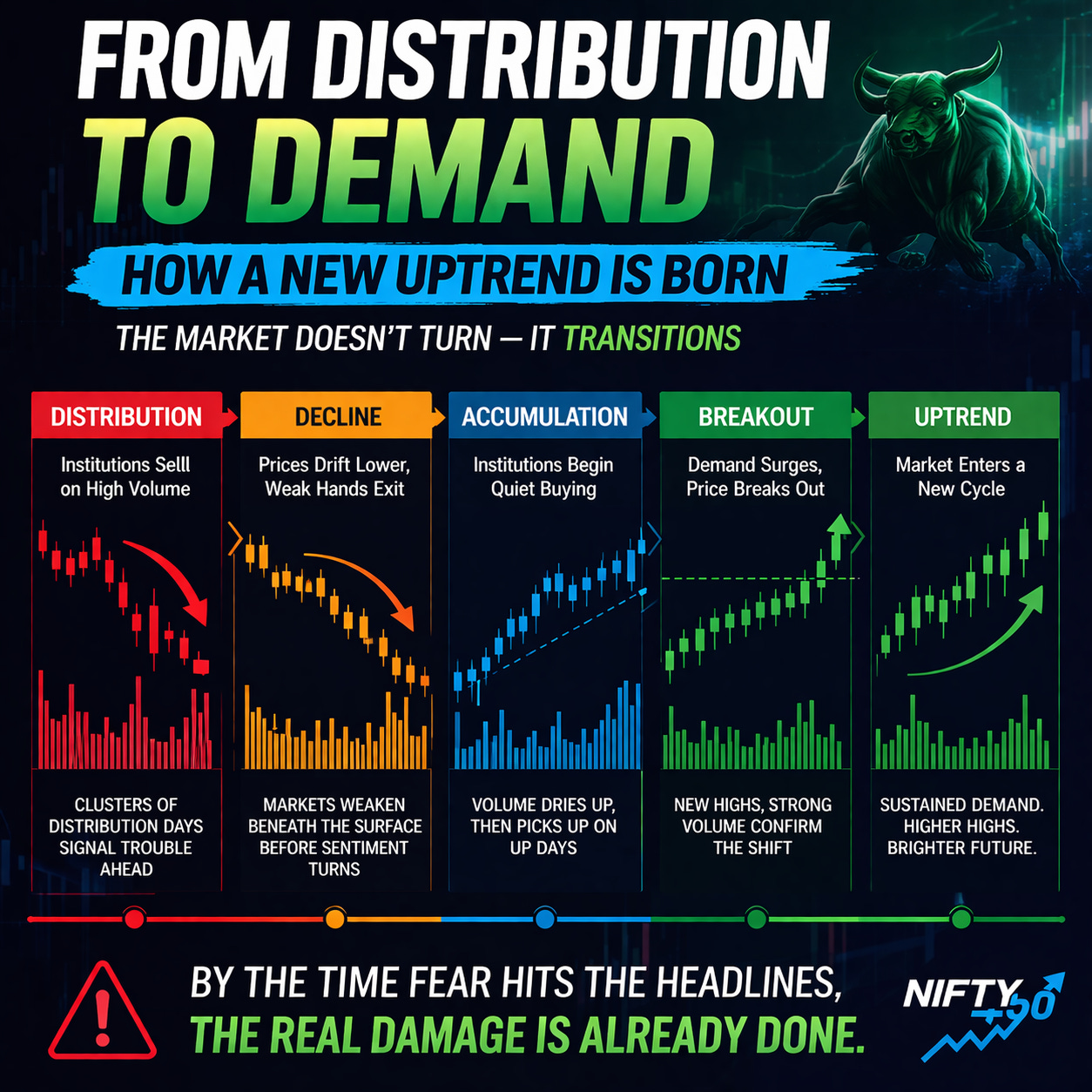
The Market Doesn’t Turn — It Transitions
A confirmed uptrend does not begin in a single session; it evolves through a structured process. The recent move in the Nifty 50 reflects a transition from institutional selling toward accumulation, marking a gradual shift in market character.
Earlier in the cycle, even as the index hovered near its highs, multiple distribution days began to emerge. These declines on higher volume indicated institutional selling pressure. As per O’Neil’s framework, clusters of such days often signal the early stages of a potential market top.
The key takeaway is clear: markets weaken beneath the surface well before negative sentiment becomes visible. By the time fear dominates headlines, much of the underlying damage has already occurred.
The Danger Zone: Rally Attempts That Fail
Following the decline, the market entered a phase of repeated rally attempts—often misleading for investors. These temporary recoveries tend to create optimism, but without institutional participation, they lack sustainability and eventually fail.
Market behavior during February and March highlighted several such attempts, where initial strength faded quickly under renewed selling pressure. This reinforces a crucial principle: a rally attempt is not a buy signal but merely a preparatory phase.
This period demands discipline. Acting on anticipation rather than confirmation often results in repeated losses. History consistently shows that premature optimism in uncertain environments is penalized.
The Role of Price and Volume — The Only Truth That Matters
By late March, the index approached exhaustion levels after a sharp decline. However, price alone does not confirm a bottom. The true signal lies in the relationship between price and volume.
A strong price move supported by higher volume indicates institutional participation. Such action reflects conviction from large market participants rather than short-term retail-driven momentum.
O’Neil’s philosophy emphasizes that price and volume together reveal the market’s true direction. When both align positively after a correction, it signals a potential shift in trend—distinguishing a temporary bounce from a meaningful uptrend.
The Follow-Through Day — A Signal, Not a Guarantee
A follow-through day is characterized by a strong price advance on higher volume after a rally attempt. Historically, such signals have marked the beginning of sustainable uptrends.
However, confirmation does not equate to certainty. A valid follow-through must be supported by improving market breadth, broader participation, and the emergence of leadership stocks.
A confirmed uptrend increases probability, not guarantees success. Misinterpreting this distinction often leads to excessive risk-taking and overexposure.
What Smart Investors Do Now
A confirmed uptrend calls for a measured and disciplined approach rather than aggressive buying. Investors should gradually increase exposure, focusing on quality setups.
Attention should be directed toward leading stocks exhibiting strong earnings growth, relative strength, and institutional demand—core CAN SLIM principles. Avoid chasing extended stocks significantly above their buy points, as they carry elevated correction risk.
Instead, prioritize breakouts from sound bases or early entries near support levels. Risk management remains critical, with strict adherence to defined stop-loss rules.
The Psychological Shift — From Fear to Opportunity
The most significant transition occurs in investor psychology. After a prolonged correction, fear dominates sentiment, causing hesitation even as market conditions begin to improve.
Interestingly, this skepticism often marks the early stages of a new uptrend. Initial advances are typically driven by cautious participation rather than widespread optimism.
This lack of confidence is not a weakness—it forms the foundation of sustainable market advances. Markets frequently rise despite prevailing doubt.
The Real Lesson — Timing Over Prediction
The key lesson lies in understanding the sequence rather than predicting outcomes. Markets typically transition through distribution, correction, failed rallies, and eventual confirmation.
Investors may not identify exact bottoms, but they can recognize improving conditions. Waiting for confirmation may mean missing initial gains, but it significantly enhances the probability of success.
This approach prioritizes discipline over prediction, forming the cornerstone of consistent investing.
Final Thought: Respect the Market, Not Your Opinion
The market rewards discipline, not opinions. A confirmed uptrend is a signal—not a promise.
The investor’s role is to interpret signals objectively and act with consistency.
Because ultimately, one principle stands above all:
The market is always right.
Investing Insights
Stock Stories: Powering the Future of Steel and Speed with Graphite India
Stock Stories: Jain REC – The “Urban Mining” Giant Leading India’s Circular Economy
Weekly Report: Downtrend. Discipline. Opportunity — This Week’s Complete Market Playbook
Stock Stories: How Atlanta Electricals Ltd is Powering India’s High-Voltage Ambitions
Stocks to Watch: 3 Stocks Nearing a Pivot Point — Rubicon Research Ltd, NLC India, and Honasa Consumer Ltd
For quicker updates join our WhatsApp channel - MarketSmith India WhatsApp Channel
What do you think? Please email us any questions or comments.