CAMS

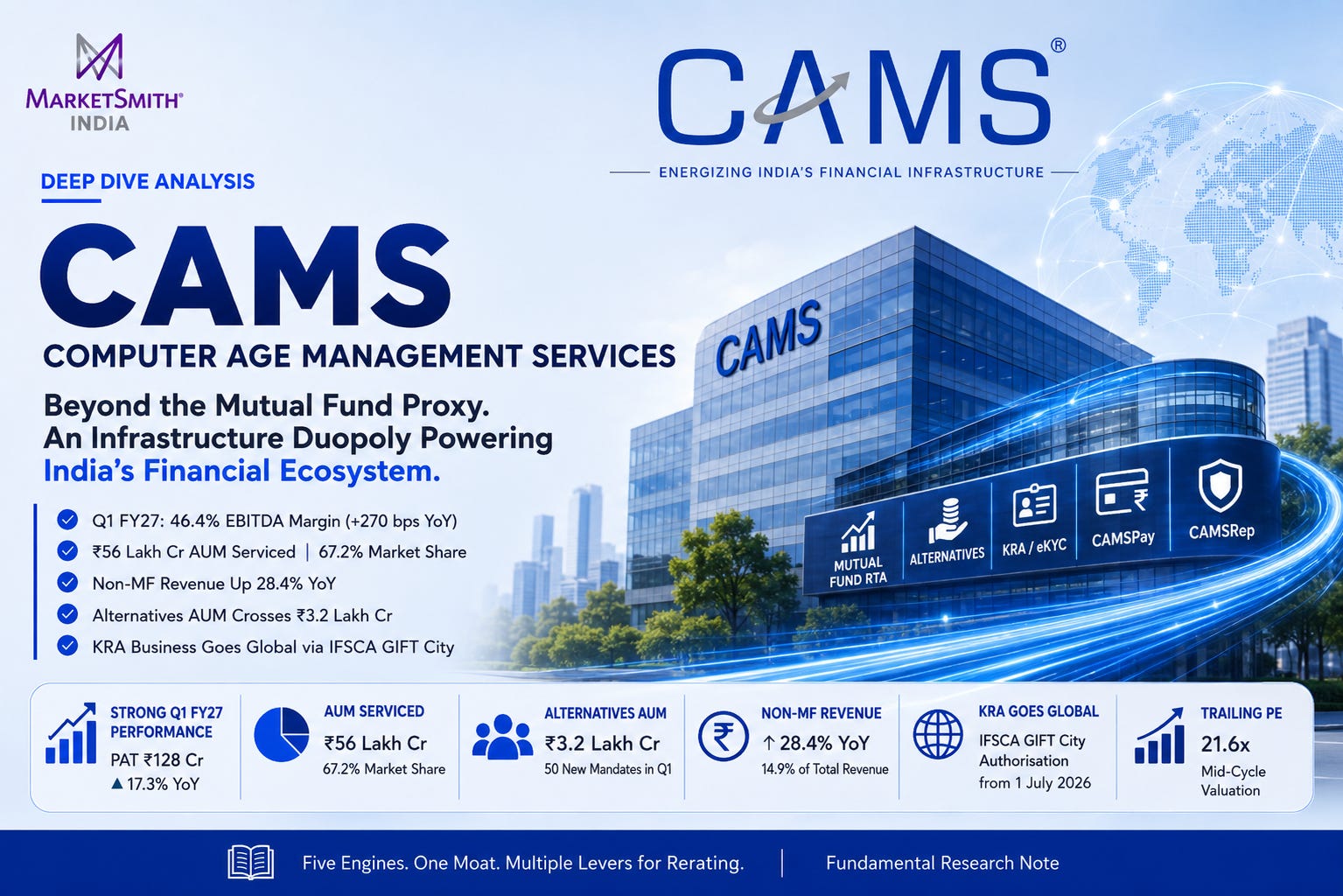
One quarter after a 46.4% EBITDA margin print, the market still models CAMS as a mutual fund derivative — missing the Rs 3.2 lakh crore alternatives book, a 46% non-MF profit engine, and a regulator-blessed KRA duopoly quietly compounding at 17% PAT growth.
In today’s newsletter, we take a deep dive into CAMS (Computer Age Management Services) and why the market may be under-pricing its transformation from a mutual fund registrar into a five-engine financial infrastructure duopoly, one where a rapidly compounding alternatives book, a newly inflecting non-MF profit engine, and a freshly authorised cross-border KRA business are converging into a structural re-rating opportunity. We explore how Q1 FY27’s 46.4% EBITDA margin — up 270 bps year-on-year despite mutual fund yield compression — validates the operating leverage thesis, why non-MF revenue growing 28.4% YoY is the second profit engine consensus still treats as an option, and how the IFSCA GIFT City authorisation turns the KRA business into hidden infrastructure for cross-border capital flows. We also examine the seven forward catalysts, the regulator-blessed duopoly moat, and the three specific bear-case mechanisms — including KFin Technologies’ share gains — that every long-term investor should keep on their radar.
Before we begin, a quick request. If you enjoy thoughtful, data-driven insights on markets, businesses, and investing, make sure you’re subscribed. And if you’re already part of our community, thank you for being with us. If you find today’s story valuable, consider sharing this newsletter with a friend or colleague who enjoys long-term investing as much as you do.
Now onto today’s story.
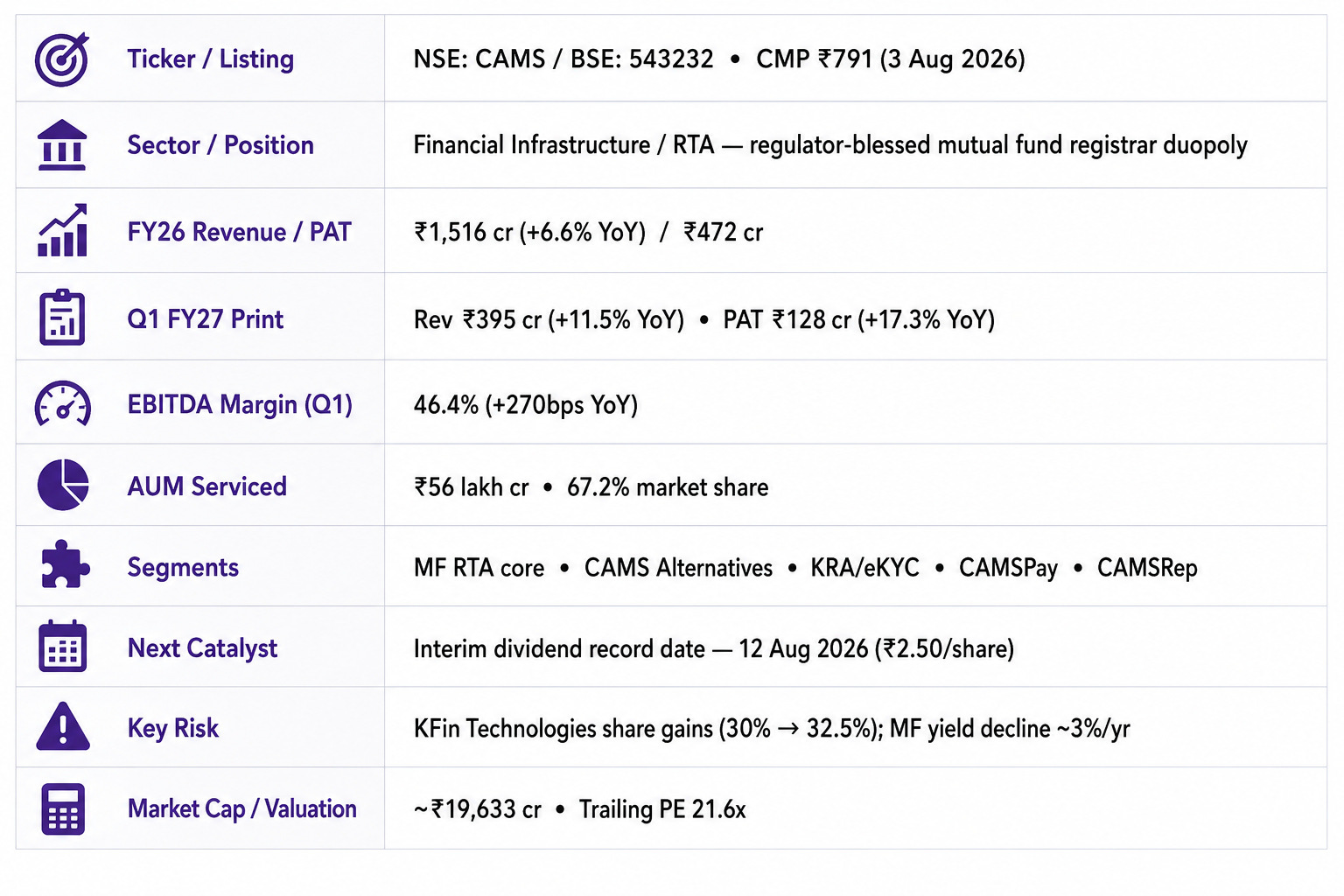
Thesis in one paragraph.
Consensus prices CAMS as a mutual fund proxy at a mid-cycle 21.6x P/E — an execution story shackled to industry AUM growth, gently ceding share to KFin at the margin, and staring down a 3% MF yield decline that will erode operating leverage. That framing misses four converging catalysts. First, the Q1 FY27 print landed Sunday with 46.4% EBITDA margin — 270bps of YoY expansion despite yield compression — proving the operating leverage thesis is structural, not cyclical. Second, non-MF revenue grew 28.4% YoY and now contributes 14.9% of revenue with a rising profitability trajectory toward 20% margin from 16.5% — the second profit engine consensus still treats as an option. Third, CAMS Alternatives crossed Rs 3.2 lakh crore AUM with 50 new mandates and 23 marquee logos in Q1 alone, a book compounding faster than industry MF AUM with 50%+ share of the outsourced alternatives market. Fourth, the KRA business becomes a hidden call option post-1 July 2026 IFSCA GIFT City authorisation — CAMS is now infrastructure for cross-border capital flows, a wedge no peer can match, priced into the stock at zero.
PROLOGUE
Why this note, why now
A monopoly toll-booth on India’s household savings — hidden in plain sight.
On Sunday, 3 August 2026, CAMS reported Q1 FY27: revenue Rs 395 crore (+11.5% YoY), PAT Rs 128 crore (+17.3% YoY), EBITDA margin 46.4% (+270 bps YoY) and AUM serviced of Rs 56 lakh crore. The board declared an interim dividend of Rs 2.50 per share with a record date of 12 August 2026. Beneath these headline numbers sits something more structural: CAMS is the invisible infrastructure layer of India’s financial savings revolution, holding a 67.2% share of an ~Rs 83 lakh crore mutual fund industry that is compounding at 20%+ CAGR — with a second, faster-growing non-MF engine that the market still refuses to underwrite.
This note takes the position that CAMS is not a mutual fund derivative. It is a regulator-blessed financial infrastructure duopoly with five distinct profit engines, operating leverage that expanded margins 270 bps year-on-year despite MF yield headwinds, and a KRA business that just became infrastructure for cross-border capital flows through IFSCA GIFT City. The consensus 21.6x P/E treats CAMS as a slow compounder tethered to AUM. The reality is a business printing Rs 128 crore of quarterly PAT at 46% margins with three optionalities — Alternatives, non-MF fintech, and international — that consensus values at zero. This note builds the case, sizes the KPIs to monitor, and states the bear case plainly.
This note is built in three layers. Section 1 decomposes the five engines the MF-proxy label misses and shows why non-MF revenue growing at more than double the pace of the MF core is the mix-shift consensus is under-weighting. Section 2 lays out seven forward catalysts running through the next four to six quarters with explicit monitoring KPIs and an honest bear case. Section 3 explains why a Rs 83 lakh crore mutual fund industry, compounding alongside a faster-growing alternatives and cross-border KYC opportunity, makes CAMS the essential infrastructure of the trade, not a slow-cycle proxy of it.
SECTION 01
Decode the business
Five engines the MF-proxy label misses.
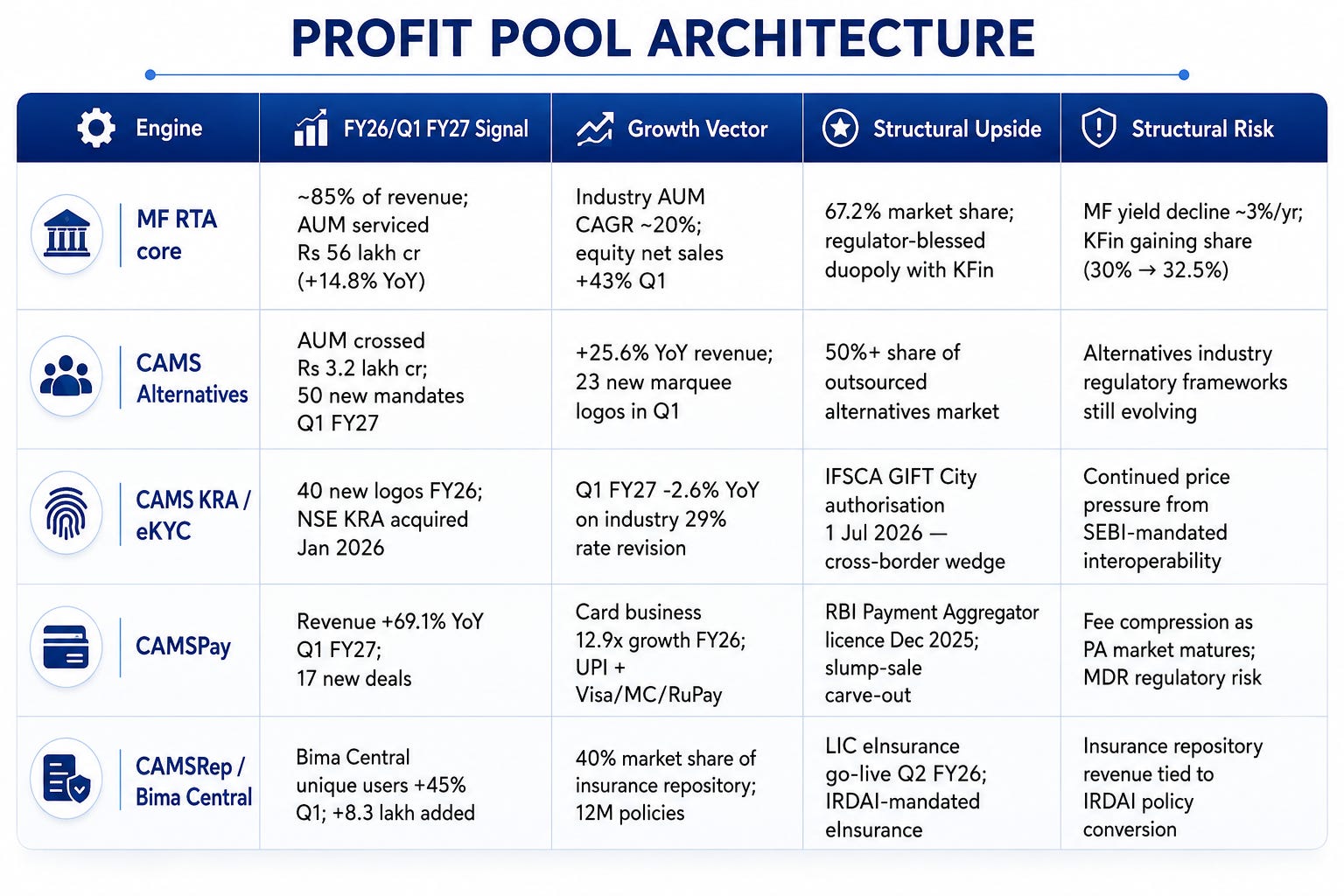
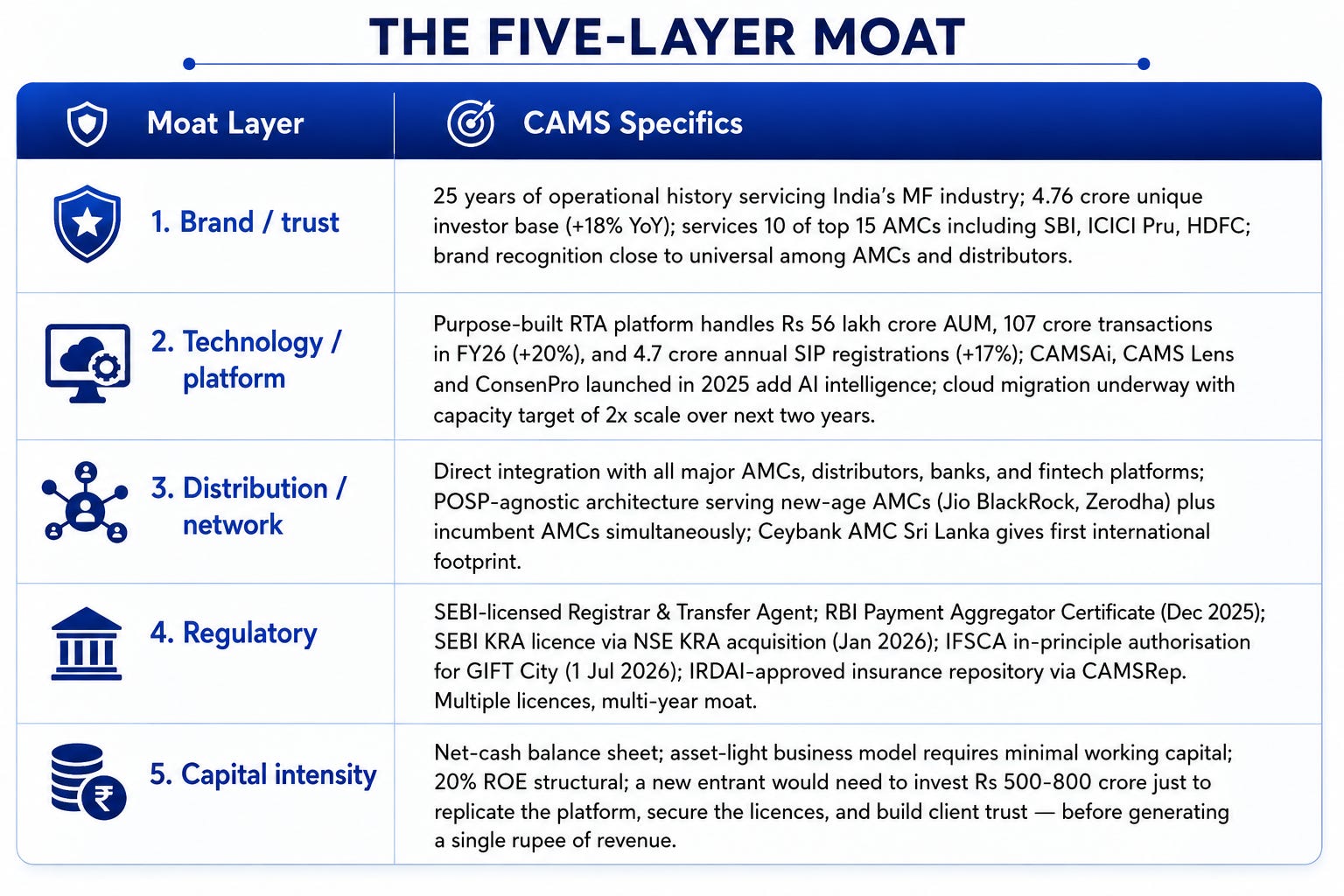
The average screener classifies CAMS as a mutual fund registrar — a back-office toll collector on India’s SIP boom. That is technically correct and analytically lazy. CAMS is a five-engine platform. The MF RTA core throws off predictable cash and buys the runway; four adjacent businesses — Alternatives, KRA/eKYC, CAMSPay payments, and CAMSRep insurance repository — are the growth optionality. Non-MF revenue is now 14.9% of the total and grew 28.4% year-on-year in Q1 FY27, more than double the pace of the MF core. Three years ago, non-MF revenue was 8-9% of the mix. The narrative is not that CAMS is decelerating; it is that CAMS is decoupling from AUM.
That decoupling has margin consequences. The MF core operates at a Rs 5-6 basis-point revenue yield on AUM — a yield that management has guided to decline about 3% per year on periodic client repricing. Non-MF businesses run at different economics: Alternatives is high-fixed-cost / high-marginal-margin as it scales; CAMSPay is a high-volume payment gateway earning per-transaction fees; CAMSRep is a data-monopoly business earning storage and query fees on 12 million insurance policies. As non-MF climbs past 20% of revenue in FY28E, blended EBITDA margins should hold in the 46-47% band — this is why Q1 FY27’s 270 bps YoY margin expansion is not a one-off, it is the structural mix inflecting.
What the numbers tell you
Engine 1 — MF RTA core (the duopoly toll booth)
The MF RTA business is a duopoly toll booth. CAMS services 10 of the 15 largest AMCs in India — including the top three: SBI Mutual Fund, ICICI Prudential Mutual Fund, and HDFC Mutual Fund. It holds 67.2% market share by AUM as of Q1 FY27; the balance is held almost entirely by KFin Technologies. Between them, the two service more than 99% of the Rs 83 lakh crore Indian mutual fund industry. This is not a competitive market — it is a regulator-blessed duopoly where SEBI licenses and 25 years of operational history are the primary entry barriers.
Recent AMC wins matter more than the share number suggests. CAMS onboarded six new AMCs during calendar 2025 alone — including Jio BlackRock, which launched India’s largest-ever NFO of Rs 17,800 crore in Q1 FY27; Angel One; Zerodha AMC; Unifi; Choice; and Taurus. Management has publicly targeted the capacity to onboard up to eight AMCs annually. Given the SEBI-driven MF industry expansion — 20% AUM CAGR plus a wave of new-age fintech AMC licences — CAMS wins the majority share of new incumbents by default. Every new AMC that goes with CAMS is a 20-year recurring-revenue annuity.
Engine 2 — CAMS Alternatives (the least-appreciated compounder)
CAMS Alternatives is the second growth engine and the least appreciated. It is a purpose-built platform serving alternative investment funds — private equity, venture capital, real estate, credit funds and hedge funds. AUM crossed Rs 3.2 lakh crore in Q1 FY27 with 50 new mandates added in the single quarter, 23 of them marquee first-time logos. Q4 FY26 was the segment’s highest-ever quarterly revenue print. Management estimates CAMS Alternatives holds 50%+ market share of the outsourced alternatives administration market. Alternatives AUM in India is growing at 30%+ CAGR versus MF at 20% — this is the compounding engine hiding inside a slow-cycle stock.
Engine 3 — CAMSPay & CAMSRep (the fintech and insurance rails)
CAMSPay and CAMSRep round out the non-MF story. CAMSPay is CAMS’s payment aggregator business — carved out into a wholly-owned subsidiary in December 2025 after RBI granted the Payment Aggregator Certificate of Authorisation. Q1 FY27 revenue grew 69.1% year-on-year with 17 new deals signed; the card business scaled 12.9x during FY26. CAMSRep operates Bima Central, India’s insurance repository, holding 40% market share and 12 million active policies. Unique users grew 45% year-on-year in Q1 with 8.3 lakh added in the quarter alone; LIC’s eInsurance conversion in Q2 FY26 is the pipe-carrier of policy volume for the next three years.
Engine 4 — CAMS KRA (the option no one is pricing)
Then there is the KRA option no one is pricing. CAMS KRA — the KYC registration business acquired via NSE KRA in January 2026 — received in-principle IFSCA authorisation on 1 July 2026 for GIFT City operations. This makes CAMS one of only two authorised KYC identifiers for cross-border capital flows into India through GIFT City. As GIFT City expands into a genuine offshore finance hub — with mandated financial services SEZ activity for foreign investors, retail expats, family offices, and cross-border AIFs — CAMS becomes the identity-and-KYC infrastructure layer. The Q1 FY27 KRA revenue declined 2.6% on the industry-wide 29% rate revision, but that is the trough. The post-IFSCA volume curve has not yet started.
SECTION 02
The forward look
Seven catalysts, eight KPIs, one explicit bear case.
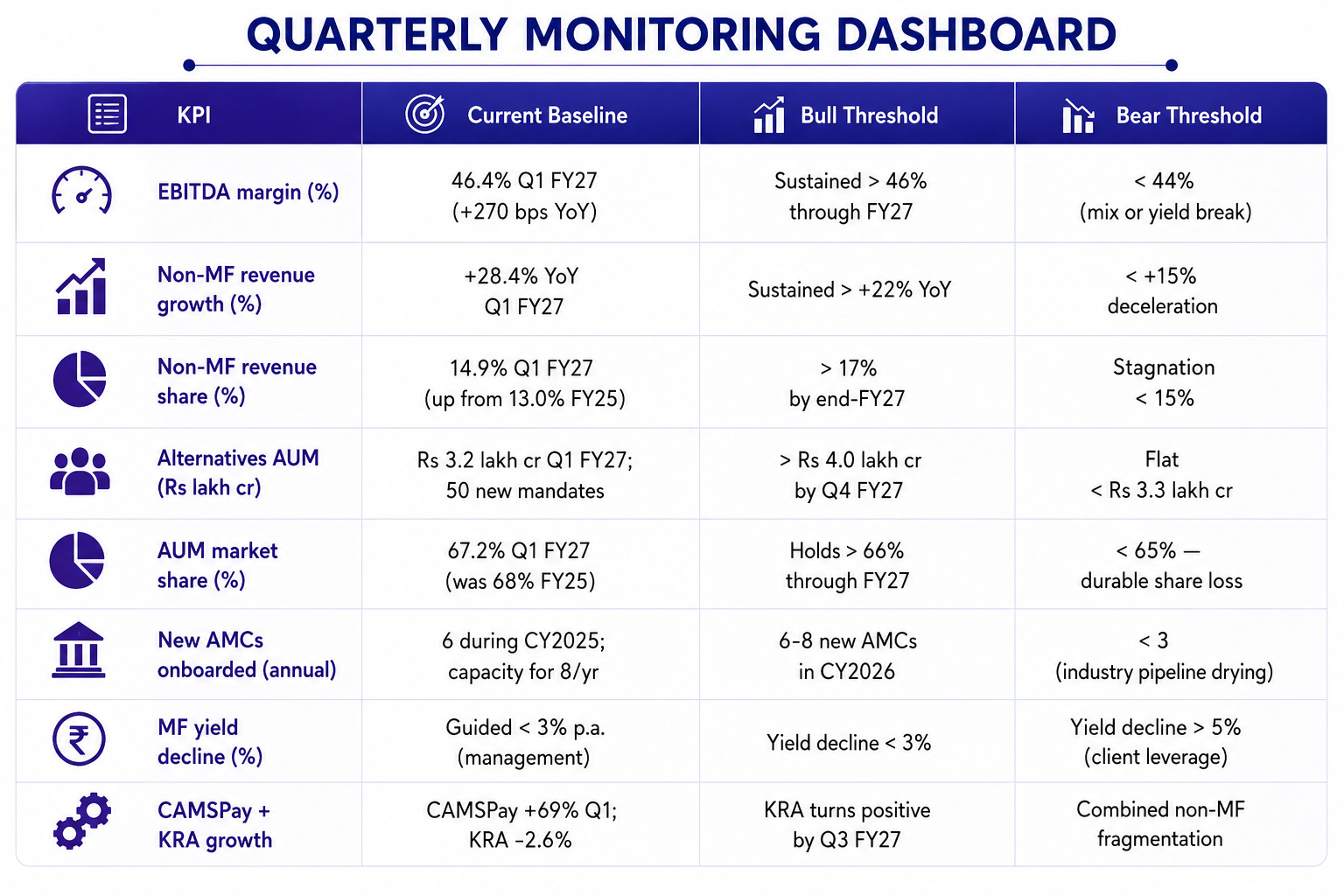
Seven catalysts converge into the next four to six quarters. Each is discrete, publicly disclosed and time-bound.
Catalyst 1 — Q1 FY27 print (delivered 3 August 2026). The Q1 FY27 print, announced Sunday 3 August, is the strongest data point of the next six weeks and it validates the mix-shift thesis. PAT grew 17.3% year-on-year against revenue growth of 11.5% — the 6-point gap is operating leverage. EBITDA margin expanded 270 bps YoY to 46.4% despite management’s own guidance that MF yield would decline. Non-MF revenue grew 28.4%; equity net sales grew 43% versus industry 39%. The interim dividend of Rs 2.50 per share on 12 August adds a small yield event. The near-term test is whether the stock re-rates from 21.6x P/E toward the 25-27x band that quality financial infrastructure typically commands in India.
Catalyst 2 — Non-MF profitability inflection to 20% margin. In the Q4 FY26 earnings call, Anuj Kumar guided non-MF profitability rising to 20% margin from the current 16.5% level over the next 6-8 quarters, with non-MF revenue growth of over 20% year-on-year. Q1 FY27 delivered 28.4% — comfortably ahead of that bar. As non-MF scales through 20% of revenue, the blended EBITDA margin holds in the 46-47% band even as MF yield declines 3% annually. This is the operating leverage flywheel — a business where MF drag is exactly offset by non-MF operating leverage, and total EBITDA compounds at 17-20% while the top line compounds at 11-13%.
Catalyst 3 — Alternatives Rs 4 lakh crore AUM milestone. CAMS Alternatives AUM crossed Rs 3.2 lakh crore in Q1 FY27 with 50 new mandates added in the quarter. At the current run-rate of new mandate additions, the Alternatives book should cross Rs 4 lakh crore by end-FY27 — a step change that would push Alternatives revenue toward 6-7% of consolidated revenue from ~4% today. Each mandate is a 5-7 year recurring administration contract; the base-rate revenue yield on Alternatives AUM is meaningfully higher than the MF core. This is the single highest-quality profit stream inside CAMS.
Catalyst 4 — IFSCA GIFT City KRA volume ramp. The IFSCA in-principle authorisation for CAMS KRA in GIFT City on 1 July 2026 opens a cross-border KYC business that had zero volume as recently as Q1 FY27. As GIFT City expands — with SEBI mandating a chunk of Category-III AIF activity to route through the SEZ, IFSCA licensing family offices and cross-border FoFs, and Indian AMCs launching offshore feeder funds — CAMS becomes the identity layer. Every dollar of foreign capital that enters India through GIFT City creates a KYC transaction fee for CAMS. Management has not yet quantified this opportunity; the market is pricing zero.
Catalyst 5 — Jio BlackRock and new-age AMC ramp. Jio BlackRock launched India’s largest-ever NFO of Rs 17,800 crore across three schemes in Q1 FY27. Together with Angel One, Zerodha, Unifi, Taurus and Choice, CAMS onboarded six new AMCs during calendar 2025 and expects several more in FY27. The revenue impact of new AMCs is back-loaded — first-year revenue is small as AUM builds, but by year three each becomes a 20-40 basis point contributor. Six AMCs onboarded in 2025 alone represent a compounding base that will drive MF revenue growth above industry AUM growth in FY28-FY30.
Catalyst 6 — LIC eInsurance and CAMSRep monetisation. LIC — India’s largest life insurer with more than 30 crore policies — went live on the CAMSRep Bima Central platform in Q2 FY26. IRDAI has mandated that all new insurance policies be issued in electronic form via a repository, and Bima Central holds 40% market share of that repository market. As LIC’s policy inflow migrates through Bima Central and IRDAI enforces the eInsurance mandate more strictly, CAMSRep revenue should scale meaningfully in FY27-FY28. The Q1 FY27 print showed 45% YoY growth in unique Bima Central users — the early signal that this monetisation is beginning.
Catalyst 7 — Fintuple + Think Analytics tuck-ins. During Q1 FY27, CAMS completed the acquisition of Fintuple Technologies as a wholly-owned subsidiary for a total consideration of ~Rs 97 lakh, and revised the Think Analytics acquisition consideration to Rs 17.73 crore with completion expected by September 2026. Fintuple is a digital transformation partner for capital-market entities; Think Analytics offers SaaS analytics and data science, with a step-down subsidiary building an AI-powered data platform for a US health-tech client. Together these acquisitions layer AI and analytics onto CAMS’s raw platform — the infrastructure that lets CAMS launch products like CAMSAi, CAMS Lens, ConsenPro and CompaREITnow. Small in dollars, strategic in optionality.
MANAGEMENT VOICE — Q1 FY27 RESULTS STATEMENT, 3 AUGUST 2026
“Q1 FY27 marked another strong quarter for CAMS, as we delivered double-digit revenue growth, sustained industry leading EBITDA margins of 46.4% and robust profit expansion despite a challenging market environment. Our diversified growth engines continue to demonstrate resilience, with non-MF businesses growing 28.4% year-on-year and our Alternatives platform crossing Rs 3.2 lakh crore in assets serviced.”
— Anuj Kumar, Managing Director & CEO, CAMS
The bear case — read honestly
The bear case is credible and management itself flags two of the three mechanisms. Three specific dynamics could unwind this thesis. Bear mechanism 1 — KFin Technologies gains share aggressively. KFin’s MF AUM share moved from 30.3% in FY22 to 32.5% in FY26 and Q1 FY27, with a stated ambition to reach 40%. KFin serves 26 AMCs to CAMS’s 27, has won recent RTA mandates from Torus and Zomato Wealth, and trades at 56x P/E — a premium that reflects the higher growth expectation baked in. If KFin captures another 3-4 percentage points of AUM share by FY29, CAMS’s MF revenue growth trails industry AUM growth by ~200 bps a year, and the operating leverage story requires non-MF to do heavier lifting. Estimated fair value impact: minus 12-18% from current levels. Bear mechanism 2 — MF yield compression accelerates beyond guidance. Anuj Kumar has guided MF yield decline of ~3% per year on periodic client repricing. In a scenario where SEBI further tightens Total Expense Ratios or where large AMCs use the KFin option as pricing leverage in renewals, yield decline could accelerate to 5-6% per year. That collapses MF revenue growth to low single digits and forces non-MF to shoulder ~80% of total growth. If non-MF stumbles even briefly, consolidated EBITDA growth flattens. Estimated fair value impact: minus 15-20%. Bear mechanism 3 — SIP stoppage ratio deterioration. The Indian mutual fund industry saw SIP stoppage ratio touch 94.5% in July 2026 versus 75.6% a year ago and 52% two years ago. New SIP registrations fell to 18 lakh in July 2026 from 65 lakh at peak. If this signals the beginning of a retail SIP cooling cycle — driven by market correction, tighter credit conditions, or generational shift toward direct equity — the underlying MF AUM growth engine slows from 20% CAGR to 12-14%. CAMS’s MF core is downstream of that trend by definition.
SECTION 03
Industry & moat
A regulator-blessed duopoly on India’s household savings.
India’s mutual fund industry closed FY26 with Rs 73.7 lakh crore of assets under management and, as of May 2026, average AUM had touched Rs 83.5 lakh crore. The industry has grown at 20.5% CAGR between March 2021 and March 2026, adding roughly Rs 8 lakh crore of AUM in FY26 alone. Behind this expansion sit three structural currents: (a) financialisation of household savings, with mutual funds’ share of gross financial savings expected to climb from 6% today toward 12% by 2030; (b) the SIP economy — Rs 3.5 lakh crore of annual SIP inflows, 10 crore+ active SIP accounts and rising participation from B30 (beyond top-30) cities; and (c) the entry of new AMCs — Jio BlackRock, Zerodha, Angel One, Choice, Taurus and Unifi — creating a market where the RTA duopoly is the essential infrastructure.
The alternatives industry is compounding faster. Indian AIF commitments have grown at roughly 30% CAGR over the past five years and are projected to keep compounding at 20-25% through FY30 as family offices, HNI wealth, and offshore capital route through AIFs and PMS structures. CAMS Alternatives, with 50%+ share of the outsourced administration market, is positioned as the natural infrastructure layer for this wave. Payment aggregation, insurance repository and eKYC are three additional TAM expansions that layer growth on top of the MF core. The most conservative reading is that CAMS’s revenue TAM triples from today’s Rs 1,516 crore over the next decade without any change in market share.
Consensus versus reality — the one sentence
The market prices CAMS at 21.6x trailing earnings as a mutual fund proxy, giving zero credit to the Rs 3.2 lakh crore Alternatives book compounding at 25%, the non-MF engine that just printed 28.4% growth at rising margins, the IFSCA GIFT City KRA wedge that has zero revenue today, and the 46.4% EBITDA margin structure that expanded 270 bps year-on-year despite MF yield decline — a business that will compound EBITDA at 17-20% for a decade and deserves a multiple much closer to the quality financial infrastructure band of 28-32x than the mid-cycle 21.6x it trades at today.
If you enjoyed this edition, share it with a friend, colleague, or fellow investor on WhatsApp, LinkedIn, or X. The best investment ideas become even more valuable when they’re shared.
P.S. Want to see the research framework behind stories like this?
MarketSmith India gives you access to the complete investing toolkit used to identify market leaders before they become consensus picks — including advanced stock screens, sector heatmaps, earnings trackers, Relative Strength rankings, and our proven CANSLIM® stock selection framework.
Start your FREE 10-day trial today — no credit card required.
→ https://marketsmithindia.com/mstool/subscription_f.jsp#/
Disclaimer: Information contained herein is not and should not be construed as an offer, solicitation, or recommendation to buy or sell securities. It is for educational purposes only.
Legal disclosures: https://marketsmithindia.com/legalAgreement
Screener is showing PE of 44. I checked the and current price, it appears correct. Pls elabortae of PE of 21 mentioned in the article